


Hyperliquid has become one of the most important venues for on-chain perpetual futures.
Perps are not just trading instruments. They generate a constant stream of market structure data: trades, liquidations, open interest, funding, user activity, vault flows, and platform-wide volume.
That data is valuable, but it is also difficult to work with directly.
Today, we’re launching the Perp Exchange API — a new Hyperliquid data surface in the Pinax Token API.
It gives developers structured access to Hyperliquid markets, OHLCV, open interest, liquidations, users, vaults, and platform aggregates through simple REST endpoints under: /v1/hyperliquid/*
Why this matters
Perp markets generate signals that traders, analysts, developers, and AI systems care about.
Liquidations show where forced exits are happening.
Open interest shows where exposure is building.
Funding and long/short bias show where market pressure is concentrated.
User and vault data make it possible to build leaderboards, copy-trading tools, portfolio dashboards, and risk systems.
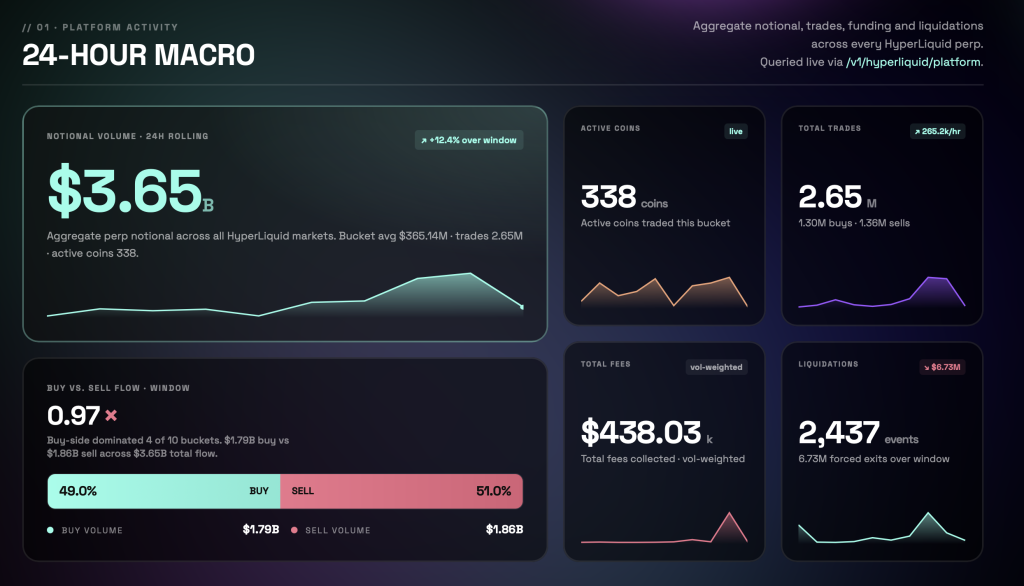
Platform aggregates show how the whole market is moving.
Across Hyperliquid, this activity is now queryable as structured data.
What we launched
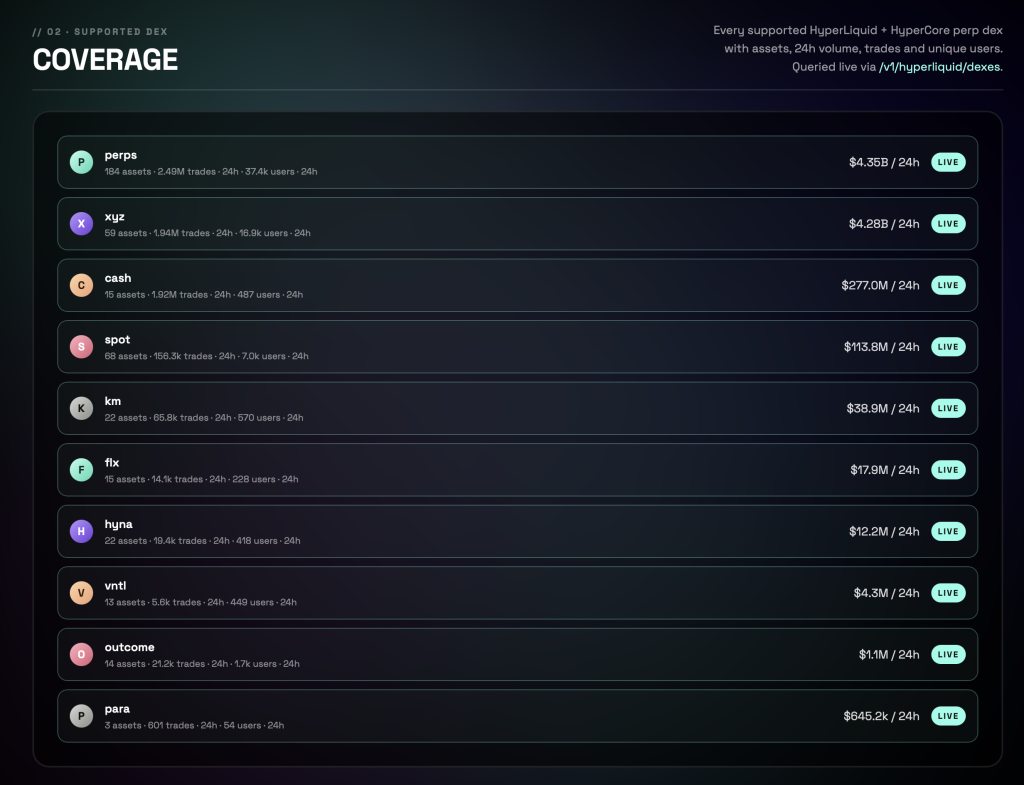
The Perp Exchange API adds 13 Hyperliquid endpoints to the Pinax Token API, grouped into four categories:
Markets
Market discovery, prices, open interest, activity, and liquidation data.
Endpoints include:
- GET /v1/hyperliquid/dexes
- GET /v1/hyperliquid/markets
- GET /v1/hyperliquid/markets/ohlc
- GET /v1/hyperliquid/markets/oi
- GET /v1/hyperliquid/markets/activity
- GET /v1/hyperliquid/markets/liquidations
- GET /v1/hyperliquid/markets/liquidations/ohlc
Users
Per-wallet trading activity, positions, P&L, fees, funding, and balance events.
Endpoints include:
- GET /v1/hyperliquid/users
- GET /v1/hyperliquid/users/positions
- GET /v1/hyperliquid/users/activity
Vaults
Hyperliquid vault flow stats and depositor-level data.
Endpoints include:
- GET /v1/hyperliquid/vaults
- GET /v1/hyperliquid/vaults/depositors
Platform
Cross-market time-series rollups for aggregate platform activity.
Endpoint:
- GET /v1/hyperliquid/platform
Together, these endpoints make Hyperliquid data easier to discover, query, analyze, and build with.
Liquidation data, without the custom pipeline
Liquidations are one of the most important signals in perp markets.
They show where leverage is being forced out, where stress is concentrated, and which markets are driving the biggest liquidation events.
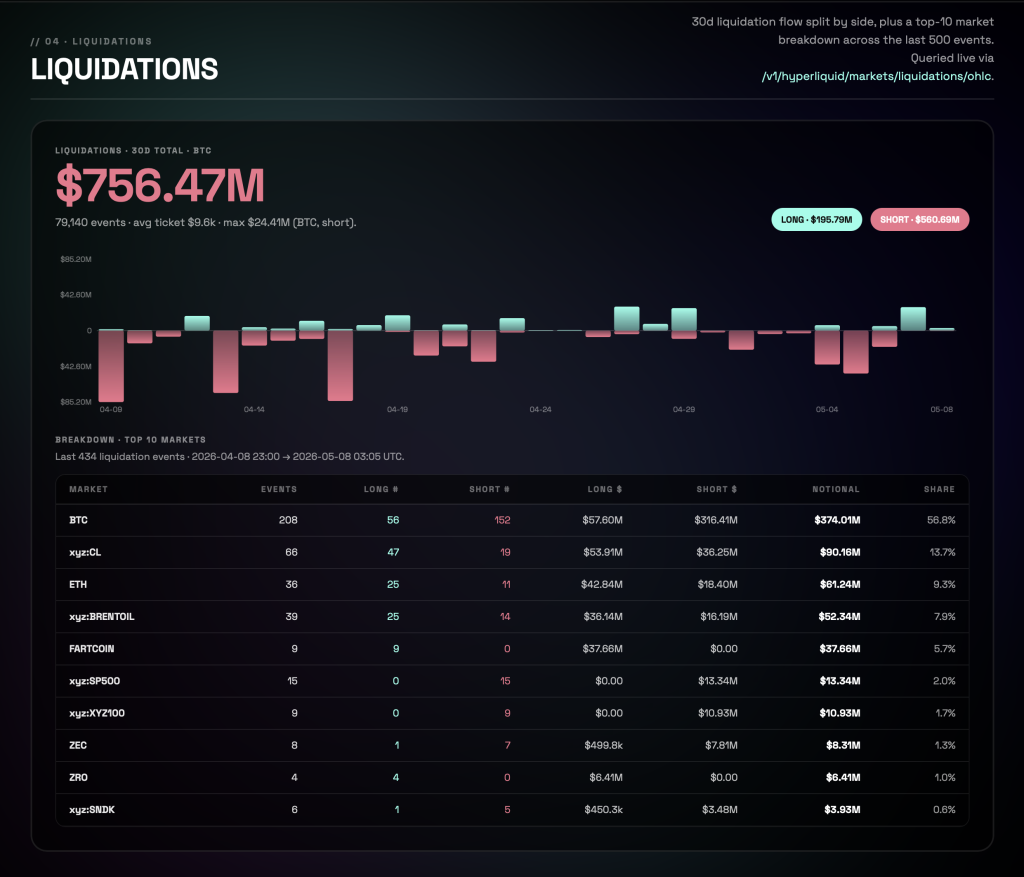
With the Perp Exchange API, liquidation data is available directly through dedicated endpoints.
You can query recent liquidation events, aggregate liquidation flow over time, and break activity down by market and side.
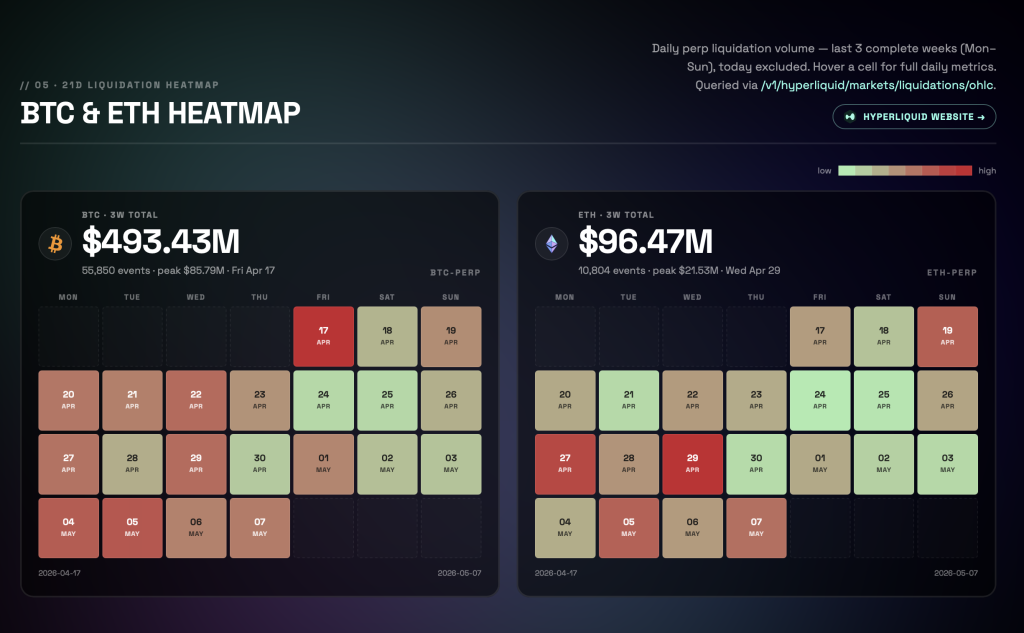
You can also turn liquidation history into heatmaps and dashboards.
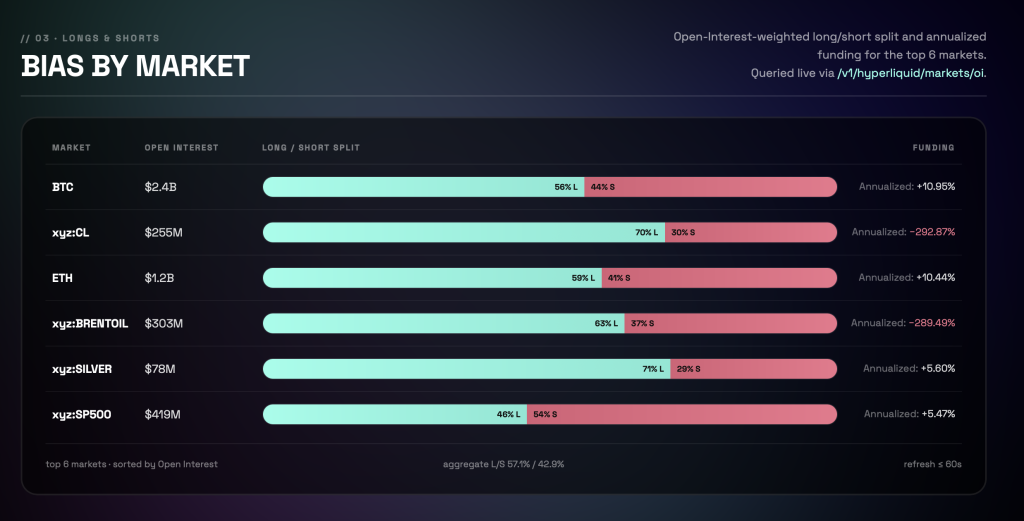
Open interest, long/short bias, and funding
Beyond liquidations, builders often want to know where exposure is concentrated.
The API makes it possible to query open interest, long/short splits, and funding data across markets.
This is useful for:
- Market monitoring
- Risk dashboards
- Funding-rate analysis
- Long/short bias tracking
- Trading agents
- Research workflows
Combining perp and prediction market data
The Perp Exchange API becomes even more powerful when combined with other Token API domains.
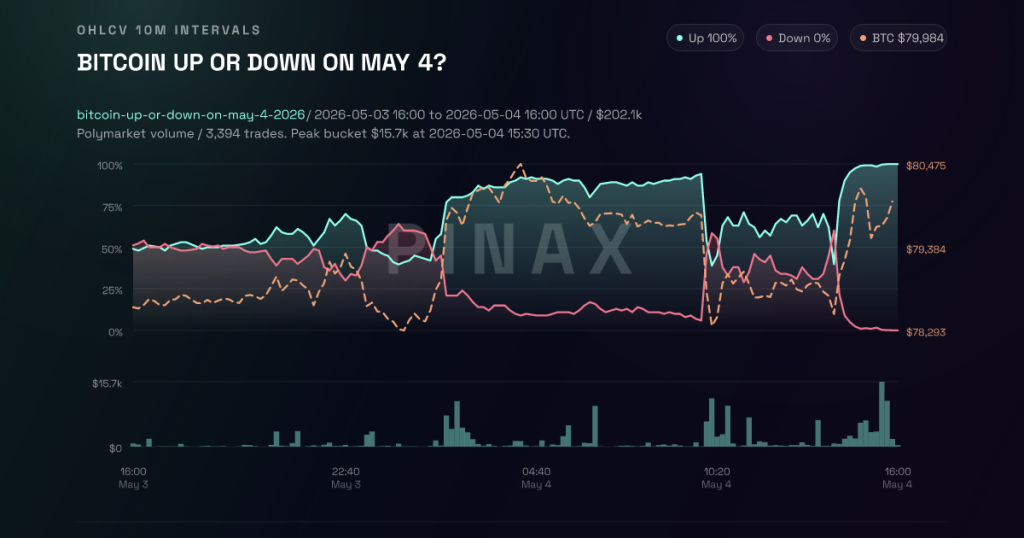
For example, builders can compare BTC price action from Hyperliquid with Polymarket probability data for daily BTC prediction markets.
That makes it possible to analyze how price movement, market expectations, and prediction-market liquidity evolve together.
You can start asking questions like:
- Did prediction market odds move before BTC price action?
- Did prediction-market volume spike before volatility?
- Where did market sentiment diverge from actual price movement?
- How do prediction markets behave around sharp perp market moves?
- Do liquidations, open interest, or funding rates explain changes in prediction-market probabilities?
This is where a unified API surface becomes especially useful: perp exchange data, prediction market data, and on-chain data can be queried together instead of stitched together from separate systems.
A simple workflow:
- Query Polymarket probabilities with /v1/polymarket/markets/ohlc
- Query Hyperliquid BTC price action with /v1/hyperliquid/markets/ohlc
- Join by timestamp
- Compare probability, price, and volume over time
From there, builders can layer in additional Hyperliquid signals like liquidations, open interest, and funding rates.
Built on HyperCore Substreams
The Perp Exchange API is built on top of Pinax HyperCore Substreams.
These Substreams process native HyperCore activity into structured streams that power the API endpoints for markets, trades, liquidations, open interest, users, vaults, and platform-level aggregates.
For most teams, the REST API is the fastest way to build: request an API key, call an endpoint, and parse JSON.
For teams that need lower-level access, custom transformations, or their own data products, the underlying HyperCore Substreams can also be accessed directly.
Pinax also supports HyperEVM Substreams, giving builders access to EVM-side activity in the Hyperliquid ecosystem.
And for teams that need direct node access, Pinax also offers RPC for both HyperCore and HyperEVM.
In short:
- Use the Perp Exchange API when you want ready-to-query Hyperliquid data.
- Use HyperCore Substreams when you want to build custom pipelines from native HyperCore streams.
- Use HyperEVM Substreams when you need EVM-side indexing and transformations.
- Use HyperCore or HyperEVM RPC when you need direct protocol access.
The API is the easiest entry point. Substreams and RPC give you deeper control when you need it.
What you can build
The Perp Exchange API is designed for teams building products on top of Hyperliquid data.
Examples include:
Liquidation dashboards
Track forced exits across BTC, ETH, and long-tail markets. Monitor liquidation volume over time, identify spikes, and break events down by market and side.
Risk monitoring tools
Combine liquidation data, open interest, funding, and long/short bias to monitor market stress.
Perp market screeners
Discover active markets, compare open interest, track recent trades, and surface where volume is moving.
Copy-trading apps
Use user endpoints to analyze trader activity, positions, fees, funding, and realized P&L.
Leaderboards
Rank wallets by volume, realized P&L, fees, activity, or position behavior.
Vault analytics
Track vault flows, depositor lists, and vault-level performance.
Backtesting workflows
Replay OHLCV, liquidation history, activity, and open-interest changes to test strategies against historical market conditions.
AI trading agents
Give agents structured access to market state, order-flow signals, liquidations, user behavior, and platform activity.
Built for developers and AI systems
The Perp Exchange API is available through the same Pinax Token API surface as the rest of our data products.
It includes:
- REST endpoints
- OpenAPI documentation
- llms.txt
- skills.md
- Browser-based “try it” docs
- API key authentication
- Free account access with credits
The goal is to make Hyperliquid data easy to use from apps, notebooks, dashboards, backend services, and AI agents.
How to get started
- Create a free Pinax account
- Log in with GitHub
- Get API access
- Explore the Perp Exchange docs
- Start querying Hyperliquid data
Start here:
Explore the Perp Exchange API docs
Product page:
Release notes:
We’re building this with you
We’re actively developing the Perp Exchange API and looking for feedback from teams building with Hyperliquid data.
If you’re building liquidation dashboards, trading tools, copy-trading apps, risk systems, vault analytics, research workflows, or AI agents, we’d love to hear what you need.
Reply or reach out directly at info@pinax.network.
We’ll respond to everyone.




No Comments